The pseudonym "Philo Vaihinger" has been abandoned. All posts have been and are written by me, Joseph Auclair.
Showing posts with label Nietzsche. Show all posts

Wednesday, October 25, 2017

Apollinian art

"But Dan Wilgus setting type on proclamations of rebellion, and Buck Titus distributing them at night on a motorcycle, may be as romantic as Xanadu . . . living in a blooming epic, right now, but no Homer come up from the city room yet to write it down!"

Musings of Doremus Jessup.

Epic elevates the sordid realities of human life - specifically, of political life - into dignity and beauty.

Even the lives of us vulgar, contemptible, and bug-ridden, naked apes.

Monday, August 7, 2017

About that eternal return

There are books I am glad I have read but would not read again.

There are movies I am glad I have watched but would not want to see again.

I note these things in answer to the pessimists' challenge that no one would want to relive the same life, in endless repetition, for all eternity.

Does it matter that, ex hypothesi, you would each time have forgotten all the previous times, so that subjectively each time would be the first and only time?

Well, think again about reading that book, or seeing that movie.

Repeatedly, again and again, for all eternity.

I think the idea of eternal return of the same book, or the same movie, as disheartening as eternal reruns of the same life, even conceding that each time will seem like the first and only time.

And yet, still, I am glad I read those books and saw those movies.

And am glad to live this life.

Tuesday, February 21, 2017

Homo politicus

It is untrue that Nietzsche has no politics.

It is just that his politics are unspeakable.

He is a bloody minded brute of the right.

He makes Hamilton look like a wild-eyed democrat.

Human, All Too Human, Part I, section 8, A Look at the State, for example.

See epigram 460, the great man of the masses, for an anticipation of Donald Trump.

In several of his epigrams, Neitzsche anticipates Ortega y Gasset and Marcel.

In others, he parrots apologists of slavery.

See 457, slaves and workers.

But see 462, my utopia.

A utilitarian, malgré lui!

See also 439, culture and caste.

His utopia, it seems, has been common in history.

Monday, February 20, 2017

Schopenhauer's greatest disciple

Nietzsche is Schopenhauer's greatest student.

He is a profound pessimist whose originality is to rather madly say "Yes" to the very same world from which pessimism has always urged flight.

Reading his biography by Daniel Halevy.

Nietzsche says he is a pessimist in the preface to Human, All Too Human, Part II, aphorism 2.

He says in aphorism 1 that Schopenhauer is his greatest teacher.

He is a pessimist who rejects romanticism, he says.

A pessimist who affirms rather than rejects life.

Saturday, March 26, 2016

Perverse bullshit

HATH, Part 1, aphorism 104, Self-defense.

Ballocks.

Rot in prison forever, you perverse bastard.

Friday, March 25, 2016

Dogmatic and silly psychological hedonism

Nietzsche's stance in at least the early sections of the first part of HATH.

For example, aphorism 103, Harmlessness of malice.

What eyewash.

Wednesday, March 23, 2016

More liberalism!

HATH aphorism 88, Prevention of suicide.

How on-again, off-again.

He is totally wrong about this

It is exactly this disparity of view for which the great one is hated and blamed.

HATH, Part I,  aphorism 81, Misunderstanding between the sufferer and the perpetrator.

All his life

HATH, Part 1, aphorism 71, Hope.

He never entirely lost his deep affinity for Schopenhauer.

The unexpected Nietzsche

On the death penalty.

HATH, Part 1, Aphorism 70, Executions.

Did you expect a liberal?

Tuesday, March 22, 2016

Nietzsche, incompatiblist

No one is responsible for his deeds, no one for his nature; to judge is to be unjust.

This he says after rejecting Schopenhauer's doctrine of intelligible freedom.

HATH, Part 1, aphorism 39.

See also Moralite larmoyante.

HATH, aphorism 91.

Ahead of his time? Still?

The Catholic Church had just dogmatically pronounced the pope infallible and the bodily assumption of Mary into Heaven.

Yet Nietzsche wrote,

Since man no longer believes that a God is guiding the destinies of the world as a whole . . . men must set themselves ecumenical goals, embracing the whole earth.

HATH, Part 1, aphorism 25.

Really?

No, not really.

Not at all.

Not on your life.

Thursday, March 10, 2016

A plague on both their houses!

HATH, Vol 1, aphorism 28.

N rejects both the theological optimism of Leibniz and the atheological pessimism of Schopenhauer.

Stages on his life's way.

Tuesday, March 8, 2016

What is Enlightenment?

And what is that famous thing invented by Isaiah Berlin and hunted by Zeev Sternhell, counter-Enlightenment?

HATH, Vol 1, aphorism 20, A few rungs down.

See also 26.

N thinks he has taken another step forward.

He does not at all see himself as counter-Enlightenment.

He is not Joseph de Maistre.

Is this about sex?

Is he thinking about Schopenhauer?

Heck, he could as well be thinking about Cohle and season 1 of True Detective.

Poor Friedrich.

HATH, Vol 1, aphorism 17, Metaphysical explanation.

Dreams and Culture

HATH, Vol 1, aphorism 12.

There are savages, according to this most un-PC 19th Century eurowhite.

Even when we don't believe him he inspires

HATH, Vol 1, Section 1, aphorism 11.

Evern to use the label correctly one must see what the thing is, and that the label applies.

To do so much is something.

Nietzsche's remarks about math and logic here are mere blathering.

Misunderstanding dreams

HATH, Vol 1, aphorism 1.

In ages of crude, primordial cultures, man thought he could come to know a second real world in dreams: this is the origin of all metaphysics.

Phooey.

Only a Kantian, or a post-Kantian, or a neo-Kantian could utter such drivel.

See also aphorism 9, of like ilk.

Tuesday, April 21, 2015

Friday, October 10, 2014

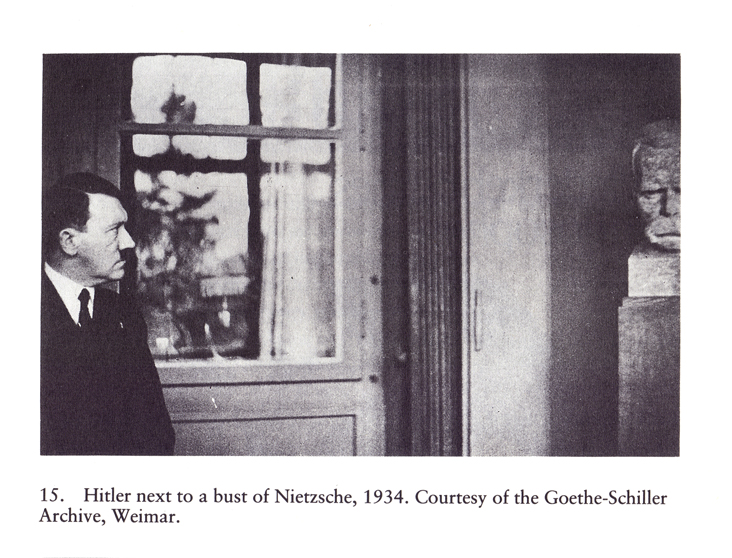
Nietzsche a Nazi? All a terrible misunderstanding

Nietzsche and Hitler


Well, in that case, Hitler wasn't the only man to misunderstand him.

There was Mencken, after all.

There is Zeev Sternhell.

There was Isaiah Berlin.

Two points.

First, who is a counter-enlightenment (or anti-enlightenment) thinker and what are its defining features depends on a prior decision who is an enlightenment thinker and what are its defining features.

If Enlightenment is essentially denial of the truth claims of religious myths, Christian or otherwise, then Hume, Rousseau, d'Holbach, and Helvetius, are as much Enlightenment figures as Kant and Locke, and Nietzsche, Marx, Darwin, and Freud are their legitimate offspring.

But if Enlightenment essentially includes faith in natural rights and justice, and that these require equality and popular government, then the latter figures are of the Counter-Enlightenment, but so is Hume, and so are Bentham and Mill. And even Voltaire!

But as to N in particular, he despised socialism, democracy, the hoi polloi, popular government, and political equality as well as a politics and a society devoted to the general welfare.

And he rejected entirely the notions of natural rights and justice.

For these things Mencken adored him.

And Hitler was not wildly off the mark to take his denunciations of the weak, his exaltation of the strong, and his exuberant praise of the "blonde beast" as an endorsement of both fascism and racism.

And, hair-splitting aside, who can deny the equation, fascism + racism = Nazism?

Though of course hair-splitting is all very well, in its place.